How to write a cover letter
Along with your CV, employers often ask for a cover letter when you apply for a job. The cover letter introduces you in a more detailed and personal way than your CV from your experience and skills to your motivation for applying and why you would be a good fit for the role. A strong cover letter helps you stand out from other candidates with similar CVs and can catch the recruiter’s attention.

Formatting a cover letter
A cover letter usually follows these formatting rules:
A4 format, maximum 1–2 pages
A formal but easy-to-read tone, without jargon or figurative language
Classic fonts (Times New Roman, Arial, Calibri), in readable sizes (10–12)
Simple spacing and short, well-structured paragraphs
Sometimes the employer may include specific formatting rules in the job posting. Always check the employer’s requirements carefully and follow them if they are provided.
The basic structure of a cover letter
A cover letter does not have a fixed structure, and you are free to express yourself. However, most cover letters include the following elements:
The initial, formal greeting. You can start with “Dear [Recruiter’s Name]” if you know the name of the person in charge of recruitment, or you can use a more generic phrase such as “To [name of the department to which the application is addressed]” or “Dear Recruiter.”
The introduction or the first paragraph of the letter: 1–2 sentences in which you mention the position you are applying for and why you are applying for the position/why you are writing the letter.
The body of the letter, which includes the following paragraphs of the letter and in which you present why you are interested in this job, what experiences you have had (educational, professional, extracurricular), and other activities or achievements that are relevant to the job you are applying for. You will need to be as concrete as possible, to offer examples, and to connect them to the company’s requirements mentioned in the job announcement. One paragraph is also dedicated to the employer, in which you explain why the position attracted you, why you would fit the role, and how your hiring would bring benefits to the employer.
Closing or last paragraph: a short paragraph in which you restate your interest and thank them for their attention.
Formal closing formula. You can use phrases like “Sincerely, [Your Full Name]” or “Respectfully, [Your Full Name]”.
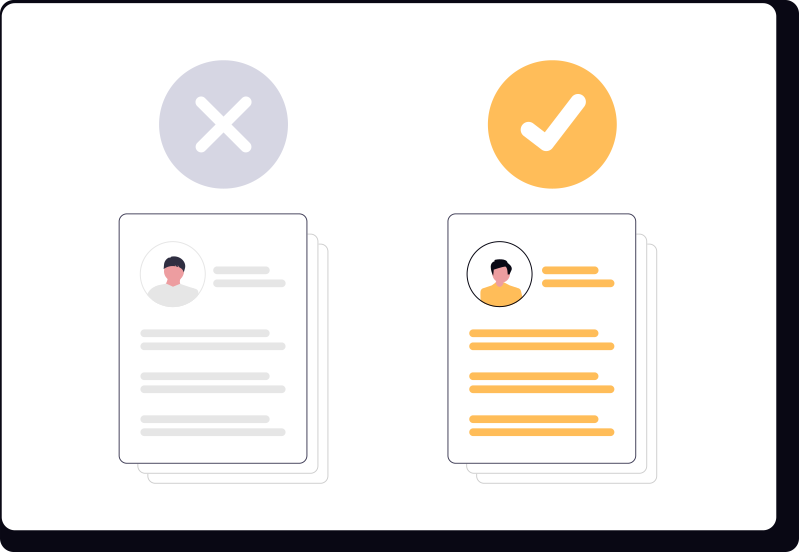
Examples of pre-filled cover letters
Tips for writing a cover letter
-
Before writing your cover letter, research the company and the role. Read the job description carefully, check the employer’s website and past activities, and include relevant details in your letter especially when explaining your motivation. Identify keywords from the job posting and use them in your cover letter.
-
The introduction is the first thing a recruiter will read, so it needs to capture attention right away. A generic opening can make the recruiter lose interest. A strong, engaging start increases the chances that your whole letter will be read.
-
When describing your skills or experience, support them with concrete examples. Questions like “Where did you learn this skill?” or “Why are you interested in this field?” help make your cover letter more personal and unique.
-
Explain clearly why you applied for this specific role at this specific company. Show that you didn’t apply randomly and that you have a clear purpose. Describe how this role supports your professional growth and how your values also match the company’s values or goals.
-
Before submitting your cover letter, make sure it has no grammar or spelling mistakes. It can help to ask a friend, parent, teacher, or counselor to review it and they may notice things you missed.
-
Just like your CV, your cover letter must be tailored to every company and role. A generic cover letter will not attract attention or respond to the employer’s needs. Use what you learned about the company and position to understand what matters most and adjust your letter accordingly.
-
Recruiters may read hundreds of cover letters, so yours should be short and to the point. Express your ideas clearly without unnecessary details. Also, recruiters do not always read letters from start to finish. A concise letter makes it easier to scan and understand.
-
Although some information from your CV will appear in the cover letter, avoid simply repeating your CV. Instead, use the cover letter to expand on your strengths, motivation, and the value you bring to the company.
-
Show not only how the position will benefit you, but also how your experience and skills will benefit the employer. Explain how you can help the company, using what you learned during your research.
-
You can use a cover letter template, but make sure the final document is easy to read for both humans and automated systems used by some companies. Use a clean design, simple fonts, readable sizes, and make sure the text is selectable (not a scanned image). Always save the letter as a PDF, not as an image (jpg or png).
Do you want to access other resources as well?
Explore a list of online resources helpful for planning and developing your career.